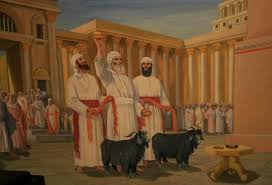
There are five main types of sacrifices, or offerings, in the Old Testament namely: the burnt offering (Leviticus 1; 6:8–13; 8:18-21; 16:24), the peace offering (Leviticus 3; 7:11–34), the sin offering (Leviticus 4; 5:1–13; 6:24–30; 8:14–17; 16:3–22), the trespass offering (Leviticus 5:14–19; 6:1–7; 7:1–6) and the grain offering (Leviticus 2; 6:14–23). There were certain elements, either animal or fruit of the field, for each of these sacrifices. Each having its specific purpose. The sacrifices or offerings were either mandatory or voluntary.
Mandatory Sacrifices
Two of the aforementioned sacrifices in the Old Covenant were mandatory. The first was the sin offering also purification offering. Its purpose was to atone for unintentional sin or sin out of ignorance and to cleanse from defilement. Five possible elements could be used for a sin sacrifice, i.e, a young bull, a male goat, a female goat, a dove/pigeon, or one-tenth ephah of fine flour. The type of animal would depend on the identity and financial situation of the offerer. The sin offering for a king was a young male goat (Lev 4:23); for the high priest or for the whole nation, a young bullock (Lev 4:3; 4:14; Num 15:24); for ordinary person, a female kid or lamb (Lev 4:28; Num 15:27); for poor individuals, two turtle doves or young pigeons could be substituted, one for sin offering, the other for burnt offering (Lev 5:7); for the very poor, one- tenth of an ephah of unscented flour(Lev 5:11).
These sacrifices each had specific instructions for what to do with the blood of the animal during the ceremony. The fatty portions and lobe of the liver and kidneys were given to God (burnt); the rest of the animal was either totally burned on the altar and the ashes thrown outside the camp (in atoning for the high priest and congregation), or eaten within the tabernacle court.
The ritual of the Sin or purification offering
During the ritual of the purification offering, the offerer placing his/her hands and pushing his/her full weight over the head of the animal, confesses his/her unintentional sin. In the case of the whole congregation the elders performed this function. On the day of Atonement, this was performed by the high priest. The animal would thereafter be slaughtered by a ritual butcher, the blood carefully collected by the priest in an earthen vessel and thrown on the two outer corners of the altar, while the fat, liver, kidneys, and caul, were burnt on the altar.
On the Day of Atonement, some of the blood would be sprinkled in front of the veil covering the entrance to the Holy of Holies and seven times in front of the mercy seat. The remainder of the blood was poured out at the base of the altar, and the earthen vessel with which the blood was collected would be smashed.
In later rabbinical interpretation the remaing parts of the animal was later consumed by the priest and his family, except when the priest himself was the offerer as in community offerings, and the Day of Atonement, when it would be burnt at a ritually clean location outside the Temple (Lev 6:30). Leviticus 6:26 stipulates that “the priest who offers it for sin shall eat it. In a holy place it shall be eaten, in the court of the tabernacle of meeting”. This point is also repeated in Leviticus 7:7, whereas Leviticus 6:29 allows that “all the males among the priests may eat it”. This suggests that the proceeds of sin offerings could be shared within the priestly community. The grain offerings was clearly shared among the priests according to Leviticus 7:10 – “Every grain offering, whether mixed with oil or dry, shall belong to all the sons of Aaron, to one as much as the other”.
The sacrificial ritual in case of a bird was altogether different. The priest would push a thumb into the bird’s neck, and wring off its head, and a second bird would then be burnt on the altar as a whole burnt offering.
The trespass offering was the second mandatory sacrifice. This sacrifice was exclusively a ram. Some consider this offering the same as sin offering though with a different animal requirement. While it sometimes seem to stand as complementary to the sin offering. The trespass offering was offered as atonement for unintentional sins, and sin that required reimbursement to an offended party, and also for a cleansing from defiling sins or physical maladies. Again, the fat portions, kidneys, and liver were offered to God, and the remainder of the ram was eaten inside the court of the tabernacle.
Voluntary Sacrifices
1. The burnt offering: This was a voluntary act of worship expressing devotion or commitment to God. It also was used as an atonement for unintentional sins. The elements of the burnt offering were a bull, a bird, or a ram without blemish. The meat and bones and organs of the animal were to be totally burnt, and this was God’s portion. The animal’s hide was given to the Levites, who could later sell it to earn money for themselves.
The second voluntary offering was the grain offering. Here, the fruit of the field was offered in the form of a cake or baked bread made of grain, fine flour, and oil and salt. The grain offering was one of the sacrifices accompanied by a drink offering of one-quarter hin (about a quart) of wine, which was poured into the fire on the altar (Numbers 15:4–5). The purpose of the grain offering was to express thanksgiving in recognition of God’s provision and unmerited goodwill toward the person making the sacrifice. The priests were given a portion of this offering, but it had to be eaten within the court of the tabernacle.
The third voluntary offering was the peace offering, consisting of any unblemished animal from the worshiper’s herd, and/or various grains or breads. This was a sacrifice of thanksgiving. In this offering there was a portion for God, the priest and the offerer. The high priest was given the breast of the animal; the officiating priest was given the right foreleg. These pieces of the offering were called the “wave offering” and the “heave offering” because they were waved or lifted over the altar during the ceremony. The fat, kidneys, and lobe of the liver were burnt unto God, and the remainder of the animal was for the participants to eat. The vow offering, thanksgiving offering, and freewill offering mentioned in the Old Testament were all peace offerings.
The sacrifices in the Old Testament pointed forward to the perfect and final sacrifice of Christ. They were “a shadow of better things that were to come; the reality of which is Christ” (Col 2:17). The New testament teaches that Christ’s atoning death on the cross is the only needed literal, ceremonial sacrifice, offered once for all (Heb 10:1-10). The only figurative or spiritual sacrifice of the new testament is good works and praise. (Hebrews 13:15,16; cf. 9:11-28; 4:14; 5:10)
 Royal Flock of Christ Church