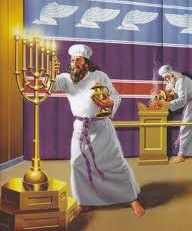
A priest is one who acts as mediator between men and God. He is duly authorized to minister in sacred things, particularly to offer sacrifices at an altar. In the New Testament the term is applied to priests of the Gentiles (Acts 14:13 ), to those of the Jews (Matthew 8:4), to Christ (Hebrews 5:5 , Hebrews 5:6 ), and to Christians (1 Peter 2:9; Revelation 1:6 ).
In the beginning every man, in a way, was his own priest, and offered his own sacrifices before God, as was with Cain and Abel (Genesis 4:3-4). The first mention of a priest in the Bible was in Genesis 14:18 with reference to Melchizedek.
Under the law of Moses, the office of the priesthood was limited to the tribe of Levi, and to only one family of that tribe, the family of Aaron. Certain laws respecting the qualifications of priests are given in Leviticus 21:16-23
[16]And the LORD spake unto Moses, saying,
[17]Speak unto Aaron, saying, Whosoever he be of thy seed in their generations that hath any blemish, let him not approach to offer the bread of his God.
[18]For whatsoever man he be that hath a blemish, he shall not approach: a blind man, or a lame, or he that hath a flat nose, or any thing superfluous,
[19]Or a man that is brokenfooted, or brokenhanded,
[20]Or crookbackt, or a dwarf, or that hath a blemish in his eye, or be scurvy, or scabbed, or hath his stones broken;
[21]No man that hath a blemish of the seed of Aaron the priest shall come nigh to offer the offerings of the LORD made by fire: he hath a blemish; he shall not come nigh to offer the bread of his God.
[22]He shall eat the bread of his God, both of the most holy, and of the holy.
[23]Only he shall not go in unto the vail, nor come nigh unto the altar, because he hath a blemish; that he profane not my sanctuaries: for I the LORD do sanctify them.
Priests were given strict rules for consecrated life. Leviticus 21:1-9
[1]And the LORD said unto Moses, Speak unto the priests the sons of Aaron, and say unto them, There shall none be defiled for the dead among his people:
[2]But for his kin, that is near unto him, that is, for his mother, and for his father, and for his son, and for his daughter, and for his brother,
[3]And for his sister a virgin, that is nigh unto him, which hath had no husband; for her may he be defiled.
[4]But he shall not defile himself, being a chief man among his people, to profane himself.
[5]They shall not make baldness upon their head, neither shall they shave off the corner of their beard, nor make any cuttings in their flesh.
[6]They shall be holy unto their God, and not profane the name of their God: for the offerings of the LORD made by fire, and the bread of their God, they do offer: therefore they shall be holy.
[7]They shall not take a wife that is a whore, or profane; neither shall they take a woman put away from her husband: for he is holy unto his God.
[8]Thou shalt sanctify him therefore; for he offereth the bread of thy God: he shall be holy unto thee: for I the LORD, which sanctify you, am holy.
[9]And the daughter of any priest, if she profane herself by playing the whore, she profaneth her father: she shall be burnt with fire.
Ezekiel 44:20-21,25-31
[20]Neither shall they shave their heads, nor suffer their locks to grow long; they shall only poll their heads.
[21]Neither shall any priest drink wine, when they enter into the inner court.
[25]And they shall come at no dead person to defile themselves: but for father, or for mother, or for son, or for daughter, for brother, or for sister that hath had no husband, they may defile themselves.
[26]And after he is cleansed, they shall reckon unto him seven days.
[27]And in the day that he goeth into the sanctuary, unto the inner court, to minister in the sanctuary, he shall offer his sin offering, saith the Lord GOD.
[28]And it shall be unto them for an inheritance: I am their inheritance: and ye shall give them no possession in Israel: I am their possession.
[29]They shall eat the meat offering, and the sin offering, and the trespass offering; and every dedicated thing in Israel shall be theirs.
[30]And the first of all the firstfruits of all things, and every oblation of all, of every sort of your oblations, shall be the priest’s: ye shall also give unto the priest the first of your dough, that he may cause the blessing to rest in thine house.
[31]The priests shall not eat of any thing that is dead of itself, or torn, whether it be fowl or beast.
Ordinances regarding the priests’ dress are stated in Exodus 28:40-43 and Ezekiel 44:15-19
[40]And for Aaron’s sons thou shalt make coats, and thou shalt make for them girdles, and bonnets shalt thou make for them, for glory and for beauty.
[41]And thou shalt put them upon Aaron thy brother, and his sons with him; and shalt anoint them, and consecrate them, and sanctify them, that they may minister unto me in the priest’s office.
[42]And thou shalt make them linen breeches to cover their nakedness; from the loins even unto the thighs they shall reach.(Exodus 28:40-42)
[15]But the priests the Levites, the sons of Zadok, that kept the charge of my sanctuary when the children of Israel went astray from me, they shall come near to me to minister unto me, and they shall stand before me to offer unto me the fat and the blood, saith the Lord GOD:
[16]They shall enter into my sanctuary, and they shall come near to my table, to minister unto me, and they shall keep my charge.
[17]And it shall come to pass, that when they enter in at the gates of the inner court, they shall be clothed with linen garments; and no wool shall come upon them, whiles they minister in the gates of the inner court, and within.
[18]They shall have linen bonnets upon their heads, and shall have linen breeches upon their loins; they shall not gird themselves with any thing that causeth sweat.
[19]And when they go forth into the utter court, even into the utter court to the people, they shall put off their garments wherein they ministered, and lay them in the holy chambers, and they shall put on other garments; and they shall not sanctify the people with their garments. (Ezekiel 44:15-19)
The manner of their consecration to the office is stated in Exodus 29:1-35.
[1]And this is the thing that thou shalt do unto them to hallow them, to minister unto me in the priest’s office: Take one young bullock, and two rams without blemish,
[2]And unleavened bread, and cakes unleavened tempered with oil, and wafers unleavened anointed with oil: of wheaten flour shalt thou make them.
[3]And thou shalt put them into one basket, and bring them in the basket, with the bullock and the two rams.
[4]And Aaron and his sons thou shalt bring unto the door of the tabernacle of the congregation, and shalt wash them with water.
[5]And thou shalt take the garments, and put upon Aaron the coat, and the robe of the ephod, and the ephod, and the breastplate, and gird him with the curious girdle of the ephod:
[6]And thou shalt put the mitre upon his head, and put the holy crown upon the mitre.
[7]Then shalt thou take the anointing oil, and pour it upon his head, and anoint him.
[8]And thou shalt bring his sons, and put coats upon them.
[9]And thou shalt gird them with girdles, Aaron and his sons, and put the bonnets on them: and the priest’s office shall be theirs for a perpetual statute: and thou shalt consecrate Aaron and his sons.
[10]And thou shalt cause a bullock to be brought before the tabernacle of the congregation: and Aaron and his sons shall put their hands upon the head of the bullock.
[11]And thou shalt kill the bullock before the LORD, by the door of the tabernacle of the congregation.
[12]And thou shalt take of the blood of the bullock, and put it upon the horns of the altar with thy finger, and pour all the blood beside the bottom of the altar.
[13]And thou shalt take all the fat that covereth the inwards, and the caul that is above the liver, and the two kidneys, and the fat that is upon them, and burn them upon the altar.
[14]But the flesh of the bullock, and his skin, and his dung, shalt thou burn with fire without the camp: it is a sin offering.
[15]Thou shalt also take one ram; and Aaron and his sons shall put their hands upon the head of the ram.
[16]And thou shalt slay the ram, and thou shalt take his blood, and sprinkle it round about upon the altar.
[17]And thou shalt cut the ram in pieces, and wash the inwards of him, and his legs, and put them unto his pieces, and unto his head.
[18]And thou shalt burn the whole ram upon the altar: it is a burnt offering unto the LORD: it is a sweet savour, an offering made by fire unto the LORD.
[19]And thou shalt take the other ram; and Aaron and his sons shall put their hands upon the head of the ram.
[20]Then shalt thou kill the ram, and take of his blood, and put it upon the tip of the right ear of Aaron, and upon the tip of the right ear of his sons, and upon the thumb of their right hand, and upon the great toe of their right foot, and sprinkle the blood upon the altar round about.
[21]And thou shalt take of the blood that is upon the altar, and of the anointing oil, and sprinkle it upon Aaron, and upon his garments, and upon his sons, and upon the garments of his sons with him: and he shall be hallowed, and his garments, and his sons, and his sons’ garments with him.
[22]Also thou shalt take of the ram the fat and the rump, and the fat that covereth the inwards, and the caul above the liver, and the two kidneys, and the fat that is upon them, and the right shoulder; for it is a ram of consecration:
[23]And one loaf of bread, and one cake of oiled bread, and one wafer out of the basket of the unleavened bread that is before the LORD:
[24]And thou shalt put all in the hands of Aaron, and in the hands of his sons; and shalt wave them for a wave offering before the LORD.
[25]And thou shalt receive them of their hands, and burn them upon the altar for a burnt offering, for a sweet savour before the LORD: it is an offering made by fire unto the LORD.
[26]And thou shalt take the breast of the ram of Aaron’s consecration, and wave it for a wave offering before the LORD: and it shall be thy part.
[27]And thou shalt sanctify the breast of the wave offering, and the shoulder of the heave offering, which is waved, and which is heaved up, of the ram of the consecration, even of that which is for Aaron, and of that which is for his sons:
[28]And it shall be Aaron’s and his sons’ by a statute for ever from the children of Israel: for it is an heave offering: and it shall be an heave offering from the children of Israel of the sacrifice of their peace offerings, even their heave offering unto the LORD.
[29]And the holy garments of Aaron shall be his sons’ after him, to be anointed therein, and to be consecrated in them.
[30]And that son that is priest in his stead shall put them on seven days, when he cometh into the tabernacle of the congregation to minister in the holy place.
[31]And thou shalt take the ram of the consecration, and seethe his flesh in the holy place.
[32]And Aaron and his sons shall eat the flesh of the ram, and the bread that is in the basket, by the door of the tabernacle of the congregation.
[33]And they shall eat those things wherewith the atonement was made, to consecrate and to sanctify them: but a stranger shall not eat thereof, because they are holy.
[34]And if ought of the flesh of the consecrations, or of the bread, remain unto the morning, then thou shalt burn the remainder with fire: it shall not be eaten, because it is holy.
[35]And thus shalt thou do unto Aaron, and to his sons, according to all things which I have commanded thee: seven days shalt thou consecrate them.
They had many duties (Exodus 27:20, 21; 29:38-44; Leviticus 6:12; 10:11; 24:8; Numbers 10:1-10; Deuteronomy 17:8-13; 33:10; Malachi 2:7).
The chief duties of the priests were
1. to watch over the fire on the altar of burnt offering, and to keep it aflame continuously both by day and night (Leviticus 6:12; 2 Chronicles 13:11).
2.to feed the golden lamp outside the vail with oil (Exodus 27:20, 21;).
3. to offer the morning and evening sacrifices, each followed by a meat offering and a drink offering, at the door of
the tabernacle (Exodus 29:38-44).
4. to teach the children of Israel the statutes of the Lord (Leviticus 10:11; 33:10; 2 Chronicles 15:3; Ezekiel 44:23,24).
During the journeys in the wilderness, it was the priests’ duty to cover the ark and all the vessels of the sanctuary with a purple or scarlet cloth before the Levites would come to carry them (Numbers 4:5-15). As the people started on each days march they were to blow “an alarm” with long silver trumpets (Numbers 10:1-8). It belonged to the priests to blow the trumpets. The presence of the priests on the field of battle (1 Chronicles 12:23,27; 2 Chronicles 20:21,22) led, in the later periods of Jewish history, to the special appointment at such times of a war priest. Priests also act in judgment on difficult matters of criminal or civil cases. (Deut 17:8-13). How long this order continued through Jewish history, considering later historical changes, is still a matter of doubt.
They offered the various sacrifices prescribed in the law while representing the people before God. The priests were divided into twenty-four courses during the reign of king David (1 Chronicles 24:7-18). Even after the Captivity, the twenty-four courses division still stood (Ezra 2:36-39; Nehemiah 7:39-42). Priests lived together in forty-eight cities assigned to their use, six of which were cities of refuge. The priest were not scattered all over the country. It was from these cities they went up by turns to minister in the temple at Jerusalem.
The office of the High Priest in Israel was of high rank and supreme importance with Aaron being the first high priest. The people through the priestly functions of Aaron were brought into a close relationship with God. Through the ministrations of the priesthood the people of Israel were instructed in the doctrine of sin and its expiation, in forgiveness and worship. The priest served as indispensable source of religious knowledge for the people. He was an authority in religious matters.
The priest’s office was of divine institution, and the priest himself divinely appointed thereto.
For every high priest taken from among men is ordained for men in things pertaining to God, that he may offer both gifts and sacrifices for sins:
And no man taketh this honour unto himself, but he that is called of God, as was Aaron. Hebrews 5:1,4 KJV
The priest was neither elected by the people, nor self-appointed. Divine selection set him apart for the office. The office and functions of the priest were strictly religious. Priests had no political power conferred upon them, and they were to be sustained from the free gifts of the people. This remained originally true although it degenerated over time through unscrupulous leadership of corrupt men, as well as political interference, and it itself became a political factor as in Christ’s days. but as originally appointed the priesthood in Israel was not a caste, nor a hierarchy, nor a political factor, but a divine establishment.
The High Priest represented the people before God. All Israel were taken as being in him. He acted for men in things pertaining to God, “to make propitiation for the sins of the people” (Hebrews 2:17 ) His representation of the people is signified in his bearing upon his shoulders two stones bearing the names of the tribes of Israel, and also in the tribal names engraved in the twelve gems of the breastplate (Exodus 28:12, Exodus 28:19) And if in his capacity a High Priest he commits a heinous sin, the guilt rubs off on the people. “If the anointed priest sins, bringing guilt on the people…” (Leviticus 4:3 NKJV). The anointed priest was the High Priest. His official action was the action of the people. When he sinned the people sinned. . The whole nation shared in the trespass of their representative. Conversely, what he did in his official capacity, as prescribed by the Lord, was reckoned as done by the whole congregation: He was a High Priest—“Every high priest chosen from among men is appointed to act on behalf of men in things relating to God…” (Hebrews 5:1 AMP ).The ordinary priests and the Levites depended for their official existence on first high priest, Aaron. Apart from him they would not be priests.

